Engineering a Real-Time 3D Custom E-Commerce Platform with React & Node.js
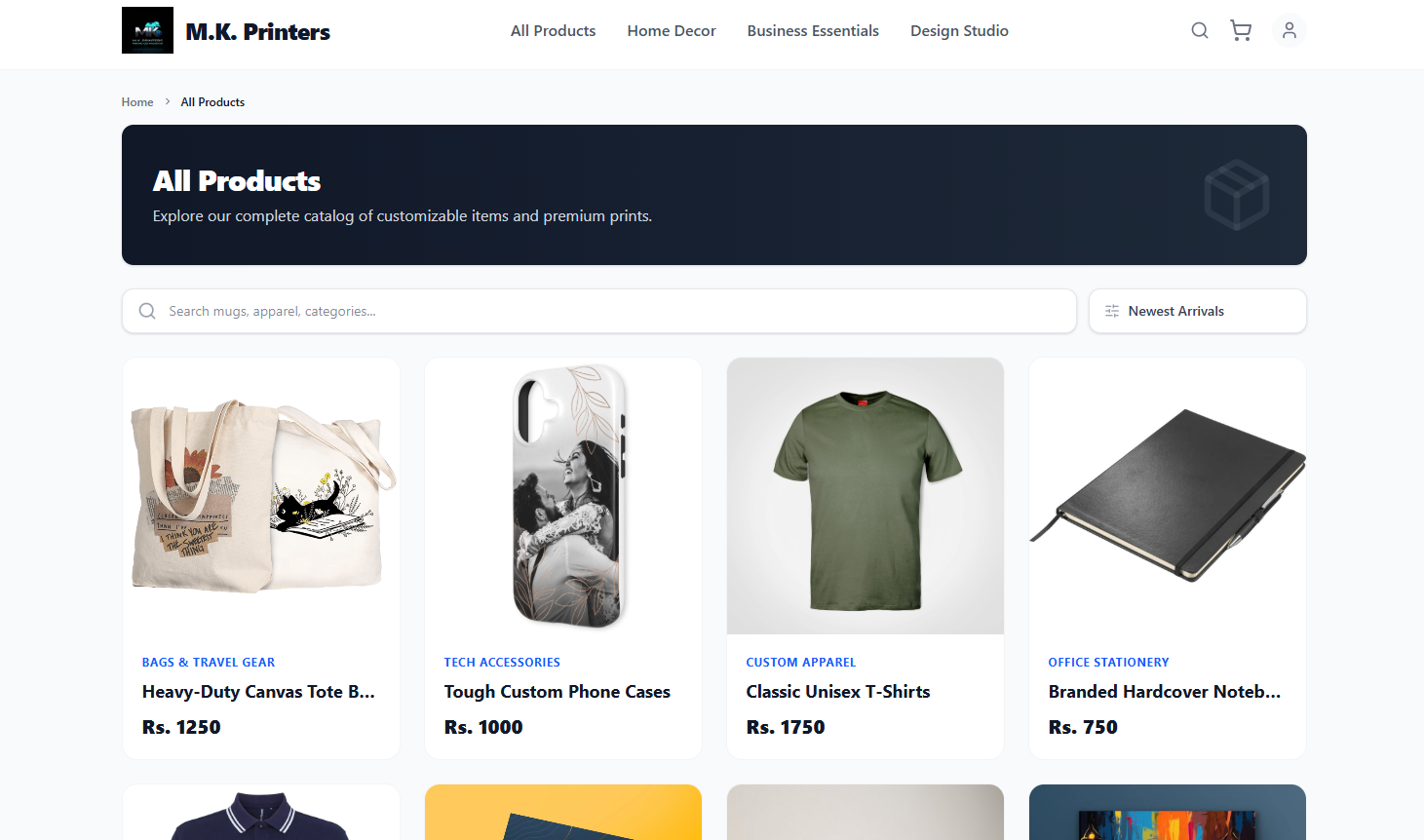
Custom printing e-commerce presents a unique architectural challenge. Unlike standard retail platforms where users simply add static SKUs to a cart, custom printing requires handling user-generated assets, real-time previews, and complex state management.
For a recent commercial project, I architected a custom full-stack MERN platform. The goal was to completely rethink the user journey—specifically, how to take a customer's flat 2D image upload and instantly map it onto an interactive 3D product model in their browser without tanking performance.
The Core Hurdle: Real-Time 3D WebGL Rendering
The biggest technical roadblock was the product customization interface. I didn't want to rely on static overlay images; I wanted users to spin, zoom, and inspect their custom designs wrapped around a 3D model (like a mug or a t-shirt) in real-time.
Doing this in a standard DOM is impossible, so the architecture relies on injecting a WebGL Canvas into the React tree using Three.js and @react-three/fiber.
However, dynamically altering a 3D model based on user input introduces severe performance bottlenecks if not handled correctly. The system has to:
Load a
.gltfor.objmodel asynchronously without blocking the main React render thread.Intercept the user's local image upload and convert it into a Three.js
Texture.Dynamically calculate the UV mapping to wrap that texture seamlessly onto a specific
MeshStandardMaterialinside the model.Allow real-time base color switching via state injection without re-rendering the entire 3D scene.
To achieve this, I utilized Suspense boundaries for the model loading and engineered a custom hook to manage the WebGL material states. When a user changes the "Base Color" via the React UI, the state update trickles down into the WebGL context, seamlessly swapping the hex value on the 3D mesh while preserving the user's uploaded texture map.
The Base64 Pipeline: Bridging the 2D DOM and 3D Canvas
Handling the user's uploaded artwork securely and swiftly was the next challenge. Initially, generating local browser blob URLs (URL.createObjectURL) for previews caused issues—these temporary files vanish when the session ends, making it impossible for the Admin to view the production artwork later.
To engineer a permanent pipeline, the frontend utilizes the FileReader API. When a user selects a design, the image is immediately encoded into a Base64 data string.
This Base64 string serves a dual purpose:
It is instantly injected into the
@react-three/fibercanvas to render the 3D preview.Upon checkout, this same payload is fired across the REST API to the Node controller, which securely uploads the asset to Cloudinary and maps the permanent CDN URL directly to the MongoDB order schema.
The Dual-Role Middleware
Beyond the 3D complexity, the platform needed to serve two distinct masters: the customer storefront and the admin production tracker.
To handle this cleanly, the Node.js backend utilizes a smart JWT authentication middleware. A single Express.js instance intelligently routes traffic by inspecting incoming JWTs. It dynamically identifies whether the token was signed locally (via standard email/password) or via an external identity provider (Google OAuth using RS256 signatures). If a new Google user enters the system, a multi-step frontend wizard seamlessly captures their delivery data before auto-creating their database profile.
Frictionless Checkout Routing
To bypass the complexity of integrating a heavy third-party payment gateway for a localized business, the checkout is routed programmatically. The React frontend compiles the cart state and encodes the exact Cloudinary asset links into a highly formatted payload, dropping the finalized production details directly to the admin.
Connect & Collaborate
Building a bridge between standard React DOM interactions and complex WebGL environments requires strict state management and an obsession with optimization. If you want to check out the underlying codebase, contribute, or discuss full-stack architectures, let's connect:
Live Preview: mk-printers.com.lk
Portfolio: tsvithana.vercel.app
Let's Connect: You can reach out directly via the contact options or open an issue on my GitHub profile!